Connect Claude Code, Cursor or any MCP client. Your AI builds, deploys, scales and fixes your apps on its own, with a database, logs and graphs included. You pay only for what runs, and every app gets its own *.appboox.com address.
Request access, then tell your AI to connect with your API key, or add AppBoox as an MCP server in Claude Code, Cursor or any client that speaks MCP. One command, no SDK.
2
Talk it through
Tell your AI to put your app online. It talks the deployment through with you: checks the resources you have, suggests whether the app needs a database and creates it on the spot, how many VMs to split it into, and which subdomain you want, like pets-valley.appboox.com.
3
Live
The app is up at https://name.appboox.com as soon as the build finishes, with Postgres, logs and graphs. Your AI keeps watching and fixes what breaks.
Built for AI agents
Built MCP-first, so your AI runs it smoothly.
MCP-integrated from day one
Deploys, builds, files, logs, metrics, databases, scaling and billing were designed as MCP actions from the start, with clear results and errors that say what to do next. Your AI operates the platform natively instead of clicking through a dashboard.
Every action, visible live
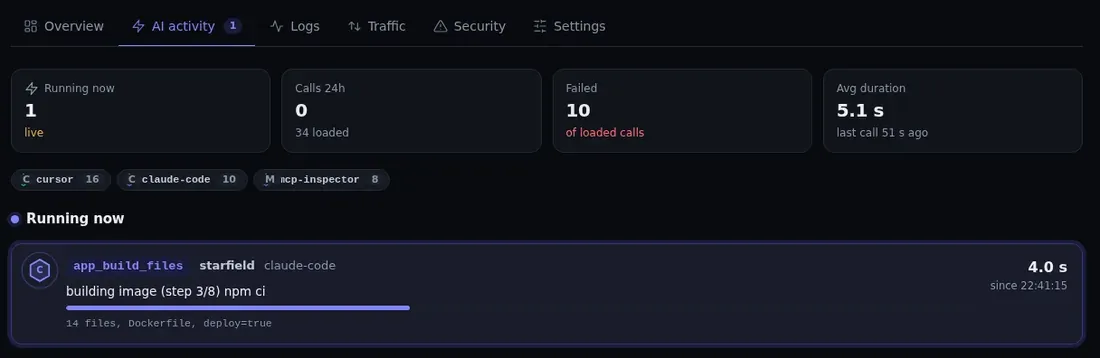
Each call your AI makes is logged: which tool, which app, how long, whether it failed. Watch it happen in the console.
No SSH needed
Deploy, files, exec, logs, database and scaling are all tools. No server keys to hand out, no shell to babysit.
Per-app tokens
Give an agent a token for one app only. It can work on that app and cannot touch the rest of your account.
A built-in advisor
Before it creates anything, your AI asks you the right questions and gets a recommendation for the class, the size and the monthly cost. A few days later it checks the choice against real usage.
Everything included
What you would normally set up yourself is already there.
A database, ready to use
Managed PostgreSQL 17 in seconds. Your AI creates, queries, resets and monitors its own databases (up to 2 per app), and the connection string is injected into the app for you.
Security handled
Every app sits behind Cloudflare and our edge with automatic HTTPS and per-IP rate limits. Each app has its own firewall and SYN-flood guard, runs isolated with hard CPU, memory, disk and bandwidth limits, and cannot reach private networks.
No IP address fees
Every app gets its own https://your-app.appboox.com address with HTTPS from the moment it is deployed. No public IP to rent, no certificates to renew, no load balancer to pay for.
Economy mode, very cheap
Half the CPU price and well under half the memory price of Standard, billed on real use only. Ideal for prototypes, staging and test copies, demos, school and hobby projects, internal tools, bots and turn-based games: anything that is fine with a short cold start.
Measured numbers
0.35 sto wake an app from scale-to-zero
2.5 sof downtime to migrate a 150 MB app to another node
Postgresincluded, up to 2 databases per app
98–101%eBPF limit accuracy, measured against the limit set
Measured on AppBoox's own cluster.
Live demo
Built by an AI, deployed through MCP.
This is Starfield Arena, a realtime multiplayer 3D game. An AI wrote it from a prompt and shipped it to AppBoox over MCP: a Node and WebSocket server, a three.js client, and high scores in managed Postgres. It is running live on the same platform that serves this page.
Touch: drag anywhere to steer, tap BOOST to dash.Keyboard: WASD or arrows to move, Space to boost.
Usage-based: you are billed on the CPU, memory and traffic your app really uses. Pick one of two classes per app. A sleeping app costs no CPU or RAM.
Standard
always on
Memory is reserved for you and the app is never paused for capacity. For production sites, APIs, live game servers and workers that must not be interrupted.
CPU
$0.024 per vCPU-hour
RAM
$0.008 per GiB-hour
RAM is billed at the larger of actual use and 25% of the limit.
Economy
much cheaper
May be paused when its node runs short of memory and wakes on the next request. Great for staging, batch jobs, low-traffic sites and turn-based backends.
CPU
$0.012 per vCPU-hour
RAM
$0.003 per GiB-hour
Billed on actual use only.
Same on both classes: disk $0.10 per GiB-month, Postgres $0.50 per database-month plus $0.20 per GiB-month plus usage beyond the included allowance.
Estimate your app
Standard
-
per month
-
Economy
-
per month
-
Estimates CPU and RAM only, before the free allowance. Disk and Postgres are billed separately.
Prices in USD; THB approximate (at 33 THB per USD). Every account gets a free allowance each month.
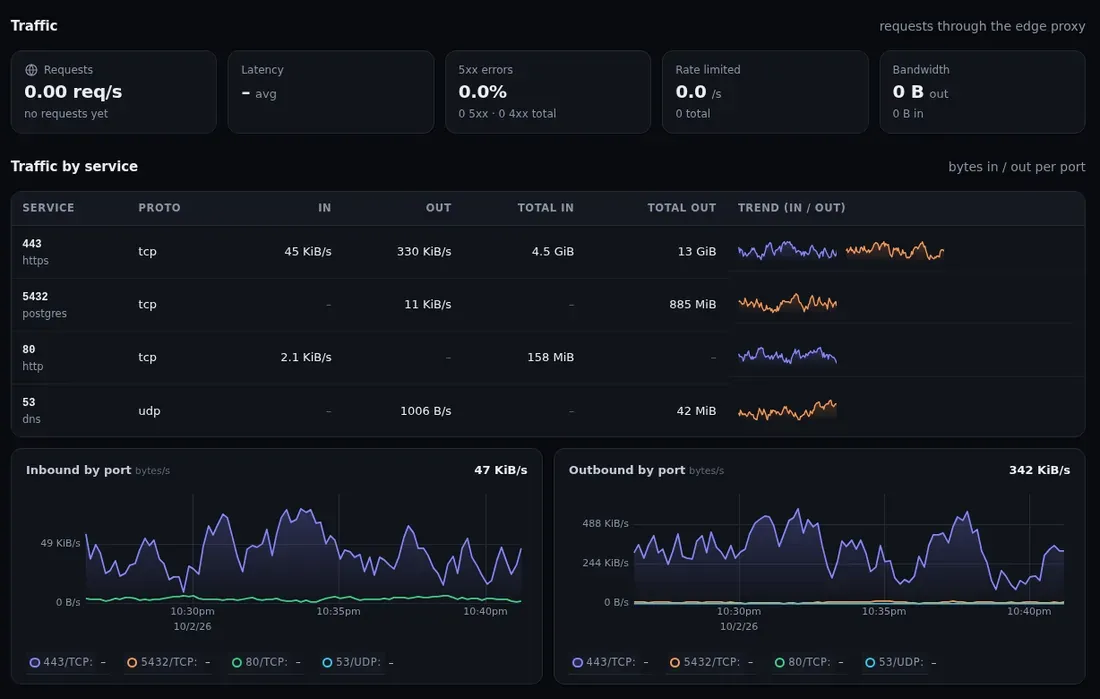
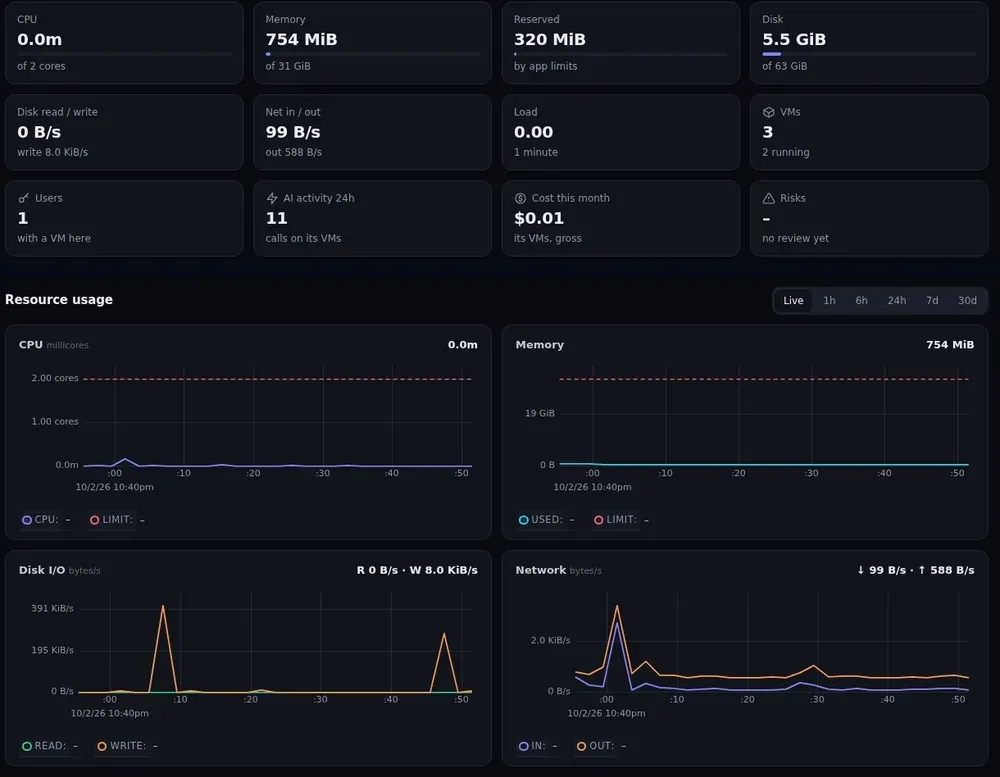
Logs, metrics, per-port traffic, an attack view and anomaly alerts are built in. These are real screenshots of the AppBoox console.
AI activity, liveEvery tool call from Claude Code, Cursor or any client, with its app, duration and result.
Traffic by portRequests, latency, status classes and bytes in and out for every port, plus the busiest paths.
Every node, at a glanceCPU, memory, disk and network for the machines your apps run on, live or over the last 30 days.
Safety
Giving an AI the keys, with guardrails.
One token per app
A separate token for each app, so a coding agent never needs your account key.
Every command logged
Nothing happens off the record. Each tool call and each shell command is kept and shown.
Anomaly alerts
Sudden CPU, disk or outbound-traffic spikes are detected automatically and flagged to the platform operators, and a per-app attack view shows suspicious traffic.
Production only
Apps run finished builds, never compilers. Builds happen in a separate build service, so a runaway job cannot eat your app.
Give your AI a place to ship.
Request access, tell your AI to connect, and ask for your first app.